

Cover Feature, Current
A Vision in Green
Ever attuned to people’s needs, Frederick Law Olmstead, the 19th-century visionary architect behind Boston’s 1,100-acre “Emerald Necklace” park system, would have appreciated some of its 21st-century priorities.
“Its year-round restrooms,” laughs Mergel, the James & Audrey Foster Executive Director of the Esplanade Association. “Restrooms are key.”
This fall, after two decades of planning and slightly more than a year after breaking ground, the Charlesbank campus and Smith Family Pavilion will be finished. At $24 million, the project is the biggest privately funded state park initiative in Massachusetts, and a long-anticipated new facility for residents and visitors. It’s also a crowning achievement for the Esplanade Association, which celebrates its 25th anniversary this year.
by Claire Vail
Ever attuned to people’s needs, Frederick Law Olmstead, the 19th-century visionary architect behind Boston’s 1,100-acre “Emerald Necklace” park system, would have appreciated some of its 21st-century priorities.
“Its year-round restrooms,” laughs Mergel, the James & Audrey Foster Executive Director of the Esplanade Association. “Restrooms are key.”
This fall, after two decades of planning and slightly more than a year after breaking ground, the Charlesbank campus and Smith Family Pavilion will be finished. At $24 million, the project is the biggest privately funded state park initiative in Massachusetts, and a long-anticipated new facility for residents and visitors. It’s also a crowning achievement for the Esplanade Association, which celebrates its 25th anniversary this year.
Built on the oldest part of the Esplanade, the Pavilion is 9,000 square feet of mostly publicly accessible space and amenities, including a café, a viewing deck, a concert area, and the Esplanade’s first permanent public restrooms. The building promises to make the waterfront usable throughout the year.
“It’s a game changer. We will basically go from a six-months-of-the-year to a 12-months-of-the-year park,” says Mergel, who has led the fundraising efforts for the Pavilion since her appointment in 2023.
“The Esplanade welcomes more than four million visitors every year. There are 35 million visits across 150 sites in the park system, and the 64 acres of the Esplanade get the most visits by a factor of ten. Now we’ll be able to serve them year-round. It’s great to see this hard work come to fruition.”
Growing Up Green
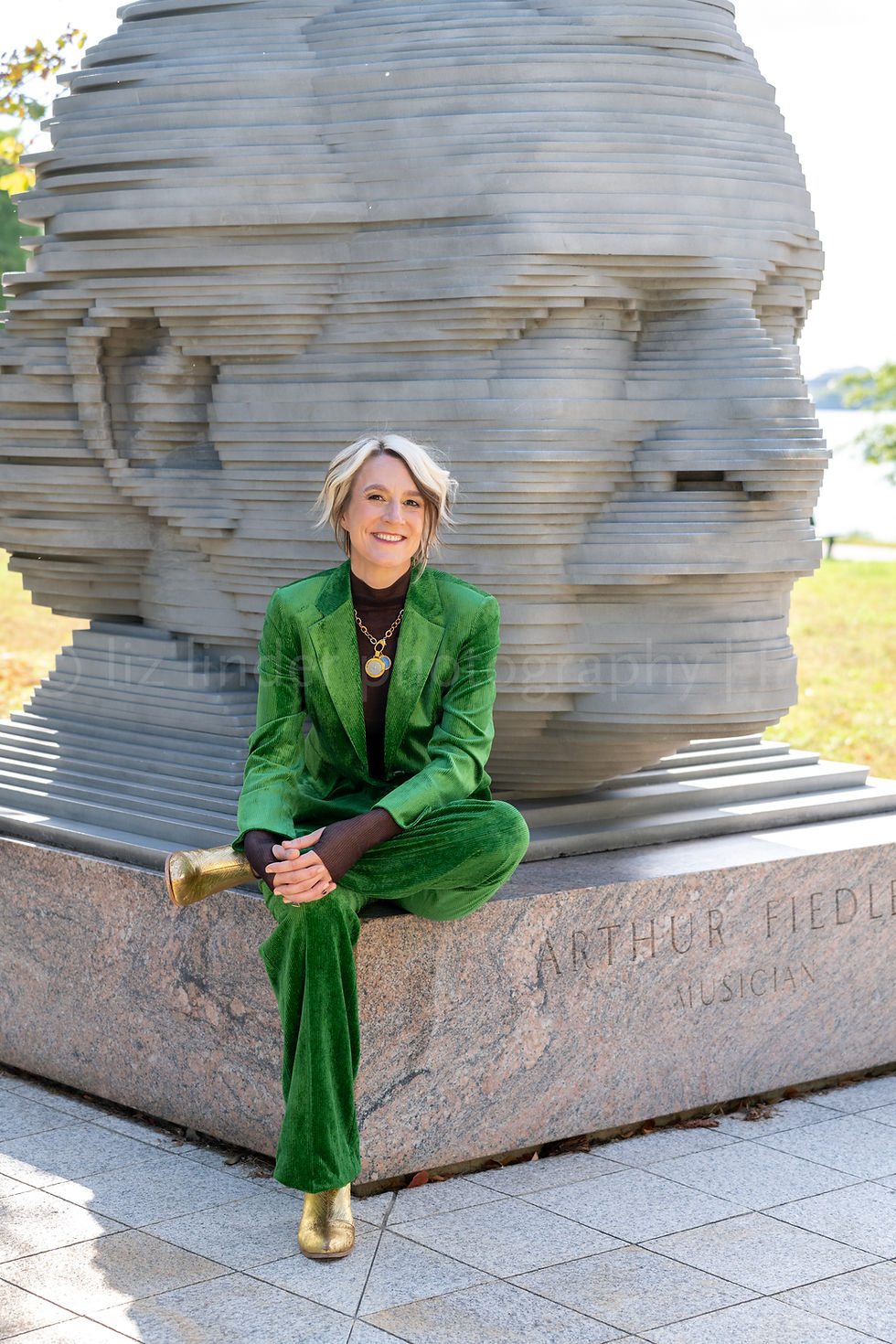
Mergel is very much still Jenny—Jen, in her case—from the block, a local who has stuck close to her roots. She grew up in Dorchester in the carefree 80s, when kids still spent their summers outdoors and mainly unsupervised. Boston’s green spaces were her stomping grounds. Mergel roamed the streets, raced her bike down the neighborhood’s steep hills, and swam in the old Lee pool, now the site of the new pavilion.
“I did not grow up with the means to travel to the Berkshires or to an island or to, you know, mountains to the north,” she muses.
Occasionally she and her brother would ride their bikes four miles from Jones Hill to Castle Island in South Boston, where they explored the waterfront that Olmsted began planning back in 1883. Mergel learned to fly a kite in Franklin Park, another of the Emerald Necklace’s jewels.
As an undergraduate at Harvard, she studied sculpture. Her thesis in visual and environmental studies involved her casting tree trunks in translucent paper so they resembled human bodies, a work that drew deeply on her childhood experiences in Boston’s parks.
She pursued a master’s in curatorial studies at Bard College in upstate New York, after which she returned to Boston to work as a curatorial assistant at the ICA, which was in the process of moving from Boylston Street to its impressive new home in the Seaport. In 2010, she left for the MFA, where she headed the contemporary art department for six years, and from there went to work with the Emerald Necklace Conservancy on public art projects. She was instrumental in bringing Japanese artist Fujiko Nakaya to Boston to display her ethereal fog sculptures across the park system
in 2018.
“I approach my work with a creative lens, having studied art and having worked with artists for over three decades. In the 1990s, I discovered that while I was not an artist myself, I loved the process of realizing other people’s artistic ambitions,” says Mergel.
Mergel was asked to help plan Olmsted Now, the Emerald Necklace’s 2022 bicentennial, which got her thinking a lot about how past values affect the present. When Olmsted Now wrapped in 2023, the Esplanade Association happened to be looking around for a new director.
Her life and career, much of it spent appreciating the importance of green spaces in people’s lives, made her the ideal candidate.
“I would never have assumed back in 1998 that spending lots of time with trees in that way would circle me back to stewarding a park with over 1,900 trees, but here I am,” says Mergel.
Unnatural Beauty
As Mergel points out, very little of Boston is natural. Most of its streets are built on landfill, a process that began in the 18th century. Architects and city planners living before the age of the automobile made critical choices that sometimes bewilder us today. Just try getting out of the city without the aid of a GPS system.
“Almost all of the physical space in this city has been shaped by people who made intentional decisions guided by certain philosophies and values, right?” Mergel asks rhetorically. “Living in a place that was created through a series of considered choices is really interesting.”
Olmsted, one of Mergel’s many heroes, expressed his democratic values and empathy for others through such choices.
“The Esplanade was born out of a public health crisis,” explains Mergel.
In the 1870s, Boston’s overcrowded West End tenements were petri dishes for germs, and cholera and tuberculosis plagued the immigrants who lived there. Olmsted built a healthy outdoor space, adjacent to the West End by the waterfront, with separate gymnasiums—one for men and another for women and children—and designed a place for people to play, exercise, and improve their mental, physical, and social health.
“He created space that demonstrably improved the quality of people’s lives, especially as the country was rapidly urbanizing after the Civil War,” says Mergel.
The Esplanade had a running track, sand pits, and climbing devices, alongside space for social gatherings. There are records of plays and concerts happening by the late 1890s. In 1914, the first outdoor film was screened at Charles Bank. The first Fourth of July concert with Arthur Fiedler and the Boston Pops in 1929 soon popularized the Esplanade with crowds looking for a place to celebrate the country’s birthday.
“It’s called the Emerald Necklace because it extends from Tremont Street, the one skinny street in Back Bay, to the landfilled South End. The park system went from Charlesbank to Charlesgate, all the way down to Franklin Park. Olmsted had originally intended to connect back to Castle Island in South Boston on the other end of the peninsula so that you
would have had this green ribbon going around the neck of the city,” Mergel explains.
“It was then, and still is, about giving people space so that they have agency to get outside, breathe fresh air, move, play and connect,” says Mergel.
A Breath of Fresh Air
By the 1990s, the Charles Riverfront was in poor shape, with broken benches, muddy lawns, graffiti, and dying trees. Neighborhood advocates Jeryl Oristaglio and Linda Cox, who lived nearby in Back Bay and Beacon Hill, respectively, took action. They, along with members of the Neighborhood Association of Back Bay and the Beacon Hill Civic Association, joined forces with Henry Lee, the founder of Friends of the Public Garden, to create the Esplanade Association in 2001.
Cox succeeded in getting the Esplanade on the National Register of Historic Places, a major step. But according to Mergel, the Commonwealth’s Department of Conservation and Recreation still doesn’t have proportional staffing and funding to do all the work required to maintain it.
The Esplanade Association currently has 16 professional staff, which will expand to 20 when the pavilion opens. While DCR holds care, custody, and control of the park, and provides basic services such as trash removal, lawn, and restroom maintenance, the Esplanade Association does the rest, along with raising money for critical improvements.
Many of those capital improvement projects have had a significant impact on the park’s usability, including the reconstruction of the river docks, building of two new playgrounds, renovating the Hatch Shell and Dartmouth restroom facilities, restoring the Lotta Fountain, revitalizing the Eliot Memorial, and restoring the Hatch Shell Oval Lawn.
“We raise funds to irrigate and maintain the Hatch Oval, so it’s not a mud pit when people put down picnic blankets. We tend to the 13 gardens in the park. We are now working on finding a way to repair the benches. We care for the trees, we put up signage, and create pathways to make sure kids don’t get hit by bike traffic. We are working with sister nonprofits to create a cleaner Charles River so you can swim in it again, like you used to be able to from 1937 to 1947,” says Mergel.
Mergel and her team are eager to see people from all of Boston’s neighborhoods enjoy the Esplanade.
“There’s a history of some people not feeling as invited as others to the park. We want that to change. We plan to offer programming that celebrates many cultural heritages. The new Pavilion has the amenities visitors have been asking for years: bathrooms with diaper-changing stations, an affordable café, and beautiful, shaded spaces for people to sit and enjoy the view.”
Mergel says she is determined to continue the long tradition of deliberate decisions started by Olmsted and carried on by others before her, choices that shape how Boston green spaces can best serve the public’s needs and wants.
“It’s our mission to make life better on the Esplanade for everybody.”
Like this article? Share it with your friends!